It is OK to use your textbook, but if you can answers the questions without it that is OK too.

I recommend you print out this page and bring it to class. Click here to show a set of five BCE student responses, randomly selected from all of the student responses thus far, in a new window.


, here are your responses to the BCE and the Expert's response.

1. Complete the following table for this compound.

Formula

Symbol of Central Atom(s) (CA)

Symbol of Terminal Atom(s)

# of valence electrons on a C atom

# of valence electrons on a Cl atom

total # of valence electrons on CCl4

CCl4


(C)


(Cl)


(4)


(7)


(32)

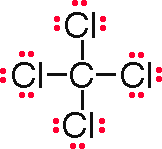
2. The Lewis structure that we drew for CCl4 is shown below,

In the image the covalent bonds between carbon and chlorine are depicted as lines and the lone pair electrons on chlorine are depicted as red circles, where each circle symbolizes an electron. Given this information answer the following questions.

a) How many electrons are represented by the line (covalent bond) between each carbon - chlorine atom?

electrons
(2 electrons make up a covalent bond.)

b) How many nonbonding electrons are on each chlorine atom?

electrons
(6 electrons are nonbonding in on each Cl atom in CCl4.)

c) How many covalent bonds does the carbon atom have?

bond
(4 bond to the central carbon atom. Remember carbon ALWAYS has four bonds. )

d) How many covalent bonds does each chlorine atom?

bond
(1 bond to the terminal chlorine atom. When chlorine, or any halogen [F, Cl, Br or I] forms only one bond when it is terminal.)

3. Formal charge is number that can be calculated for each ATOM in a Lewis structure. For any atom in a Lewis structure the formal charge can be calculated using the following equation;

Atom's Formal Charge (FC) = # valence electrons on the atom - 0.5 * bonding electrons on the atom - # of nonbonding electrons on the atom

As an example in the Lewis structure for CCl4 above, we can use the formal charge equation to determine the formal charge on the carbon atom and on all of the chlorine atoms.

For C in CCl4:

C has 4 valence electrons, 8 bonding electrons and 0 nonbonding electrons.

FC (C) = 4 – 0.5*8 – 0 = 0

For Cl in CCl4:

Cl has 7 valence electrons, 2 bonding electrons and 6 nonbonding electrons.

FC (Cl) = 7 – 0.5*2 – 6 = 0

Based on these calculations the formal charge on carbon in CCl4 is 0 and the formal charge on each chlorine atom in CCl4 is also 0.

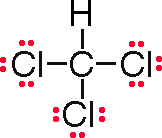
4. Below is the Lewis structure for chloroform, CHCl3.

Complete the following table:

Formula

Formal Charge on C

Formal Charge on H

Formal Charge on Cl

CHCl3


(FC(C) = 4 - 0.5*8 - 0 = 0)


(FC(H) = 1 - 0.5*2 - 0 = 0


(FC(Cl) = 7 - 0.5*2 - 6 = 0

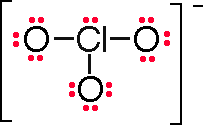
5. Draw your own Lewis structure for ClO3 and complete the table below;

Formula

Formal Charge on Cl

Formal Charge on O

ClO3


(FC(Cl) = 7 - 0.5*6 - 2 = +2


(FC(O) = 6 - 0.5*2 - 6 = –1

There are 3 oxygen atoms each with a formal charge of -1. So looking at the total polyatomic ion with the chlorine atom having a formal charge of +2 and three oxygen atoms with a formal charge of -1 each the total charge on the ion is +2 + (-3) = -1.

Answer the following questions using bond energies or Table 8.4 on page 330:

6. How much energy (kJ mol-1) is required to break,

H-H bond in H2?


(436)

Cl-Cl bond in Cl2?


(242)

H-Cl bond in HCl?


(431)

7. How much energy (kJ mol-1) is released when forming,

H-H bond in H2?


(-436)

Cl-Cl bond in Cl2?


(-242)

H-Cl bond in HCl?


(-431)

8. Write the formation equation for HCl(g).

(1/2H2(g) + 1/2Cl2(g) ----> HCl(g))

9. How much energy is required to break the bonds in the reactants in the above formation equation?

kJ mol-1
(339 kJ mol-1)

10. How much energy is released when forming the bonds in the products in the above formation reaction?

kJ mol-1
(431 kJ mol-1)

11. What is H˚ for the formation reaction?

kJ mol-1
(-92 kJ mol-1)

12. Is there anything about the questions that you feel you do not understand? List your concerns/questions.

13. If there is one question you would like to have answered in lecture, what would that question be?