It is OK to
use your textbook, but if you can answers the questions without it that is OK
too.
I recommend you print out this page and bring it to class.
, here are your responses
to the BCE and the Expert's response.
1. Select a gas for your experiment by clicking on the
appropriate radio button.
Enter the gas you used in your experiment.
Using your mouse, drag the piston to compress the air
sample and release the mouse button. Do this at least six times to collect
pressure data for volumes ranging from 5mL to 30mL. Record your data
in the following table.
2. Enter your data in the table below;
Volume (mL)
Pressure (psi)
3. How would you describe the relationship between pressure and volume as illustrated in the data you collected? (Pick all that apply.)
a) As volume decreases, pressure increases;
b) As volume decreases, pressure decreases;
c) As volume decreases, pressure remains constant;
d) As volume increases, pressure increases;
e)
As volume increases, pressure decreases;
f)
As volume increases, pressure remains constant;
In this question there are two possible responses to the question: e) as volume increases, pressure decreases and a) as volume decreases, pressure increases. Both reflect the inverse relationship between volume and pressure for an ideal gas.
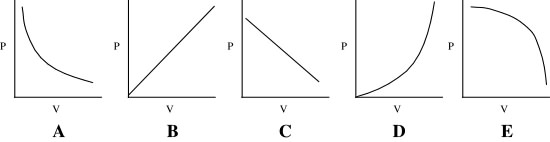
4. Which of the following graphs best describes the relationship between pressure and volume?
The best graph that reflects the inverse relationship between volume and pressure is A. Plotting the data from Q2 generates a graph that looks most like A.
5. Which of the following best describes the algebraic relationship between P and V in your gas sample? (You may want to do a fast plot of your data.)
a) P/V = constant
b) P + V = constant
c) PV2 = constant
d) PV = constant
e) P = V + constant
The best mathematical representation of the inverse relationship between P and V is choice d), P*V = constant.
6.Watch this video.
A small amount of water was added to the container, then the container
is heated. When the can is inverted and placed in the liquid water is
the pressure outside the container greater than, less than or equal
to the pressure inside the container? Explain.
The pressure outside the pop can
is greater than the pressure inside the pop can. Since the can contained
water, and the can and water are heated the water boils and drives out
all the air. When the can is inverted into the water in the beaker all
the water vapor inside the can condenses and the pressure drops to very
low inside the can compared to outside the can and the can is crushed.
5. Is there anything about the questions that you feel
you do not understand? List your concerns/questions.
6. If there is one question you would like to have answered
in lecture, what would that question be?