Welcome to The Acid/Base chemistryweb-site
In this website we will discuss the chemistry of Acids and Bases, as we know Acids and Bases can be considered as the most important chemicals in our lives, so we will take a closer look at Acids and Bases and their general characteristics. we will start with the general characteristics of Acids.
General characteristics of Acids.
- Acid came from the latin name "acidus". which is an adjective means "sour" having a sharp sour taste.
- When an acid disslove in water, it will conduct electricity.
- When blue litmus paper (an indicator) is immersed in an acidic solution, this acidic solution is going to change the color of the litmus paper from blue to red.
- Acids react with carbonates ion to produce carbon dioxide.
- When an acid reacts with a metal such as Fe, Zn, Mg, Sn, it will liberate
H2 gas.
Mg(s) + 2HCl(aq)
 MgCl2(aq) + H2(g)
 - Acids neutralize Bases to form salt and water.
Acid + Base
salt + water
HCl + NaOH
NaCl + H2O - Acid is the proton donor in the acid-base reaction.
General characteristics of Bases
- The common name of base is LYE.
- When bases dissolve in water, it will conduct electricity.
- When red litmus paper (an indicator) is immersed in a basic solution, this basic solution is going to change the color of the litmus paper from red to blue.
- Bases have a bitter taste, with a soapy slippery feel.
- Bases neutralize Acids to form salt and water.
Acid + Base
salt + water
HCl + NaOH
NaCl + H2O - Base is the proton acceptor in the acid-base reaction.
Postulated Theories for Acid-Base Definition
There are three theories talked about Acid-Base definitions. These theories started with Svante Arrhenius, then followed by Bronsted-Lowry Acid-Base theory, and the last theory was for Lewis Theory
the chemical work started earlier with the swedish chemist, in 1884, Svante Arrhenius, proposed the first scientific definition of acid and base.
Arrhenius defined an acid as any substance that contains hydrogen and when dissolved in aqueous solution produces hydrogen ions (Protons)(H+) and anions.so it will increase the Hydrogen ion concentration in water by the proton donation.
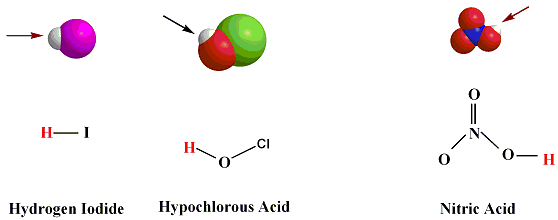
In Writing the acid formula, we need to write the formula of the H atom first before the anion formula.
examples of acids. HF, HI, HCl, H3O+, H3PO4, HNO3, are all acids.
while, NO3-, PO43- are not acids.
The effects in color change from blue litmus paper to red ,the sour taste of the Acidic compounds,the reaction with active metals and evolution of hydrogen gas due to the presence of hydrogen cation (H+) in the aqueous medium.

Arrhenius definition of a base or (Metal Hydroxide) as a substance that contains a metal and Hydroxide (OH-) group and Produces hydroxide ions (OH-) in the aqueous solution. so it will increase the OH- concentration in water. can be represented by the formula M(OH)n. where M stands for a metal atom, and (OH-) is the Hydroxide Ion.
NaOH Na+ + OH-